
A factory visit answers questions a trading-company website cannot, because production capacity, quality control, and the legal name on the documents only become clear when you can see the lines and read the license.
Overseas importers and project buyers are not only choosing a lock. They are choosing who will make it, who will appear on the contract, and who will still be reachable if a batch has a defect. A polished catalog can be assembled by a trader who does not own the process. A factory can still be a poor fit if it cannot show how it machines, assembles, tests, and traces a lock. This article is a practical vetting sequence for that decision. For the product-specification side of the same project—door type, unlock methods, connectivity, and power—use How to Specify a Smart Lock for Overseas Residential, Apartment, and Commercial Projects.
The Hobere brand is manufactured by Zhongshan Hongtu Intelligent Technology Co., Ltd. (中山弘途智能科技有限公司). The business license is in Zhongshan. Do not treat other trading-style or regional names as the official public legal entity on purchase documents.
Start with the legal name, the address, and who can sign the contract
The first filter is whether the company that is selling to you is the company that is licensed to manufacture, and whether those names match on the quotation, invoice, and warranty.
Ask for the legal name in Chinese and English, the unified social credit code or equivalent business-license details, and the factory address. Then compare those documents with the name that will appear on the contract. If a sales office, a brand name, and a factory license all use different entities, ask which entity is the contracting party and which entity actually produces the goods.
For Hobere, the official public legal name to use when a legal name is required is Zhongshan Hongtu Intelligent Technology Co., Ltd. The public factory address listed on the site is Building 2, Minsen Information Technology Industrial Park, Sanjiao Town, Zhongshan City, Guangdong Province, China. The public contact email is hongtusmartlock@hobere.com. The About and Contact pages are the public starting points; if any older page still shows another company style, the legal name above is the one to use on official documents.
Certificates should be read with the same care. An ISO 9001:2015 certificate may be mentioned only as held by SHENZHEN HONGBOHUI TECHNOLOGY CO., LTD., with validity through 20 October 2027. That certificate must not be written as if the Zhongshan company holds it. CE or EMC documents, where they exist, apply only to the models named on them and should not be extended to current featured models that are not listed.
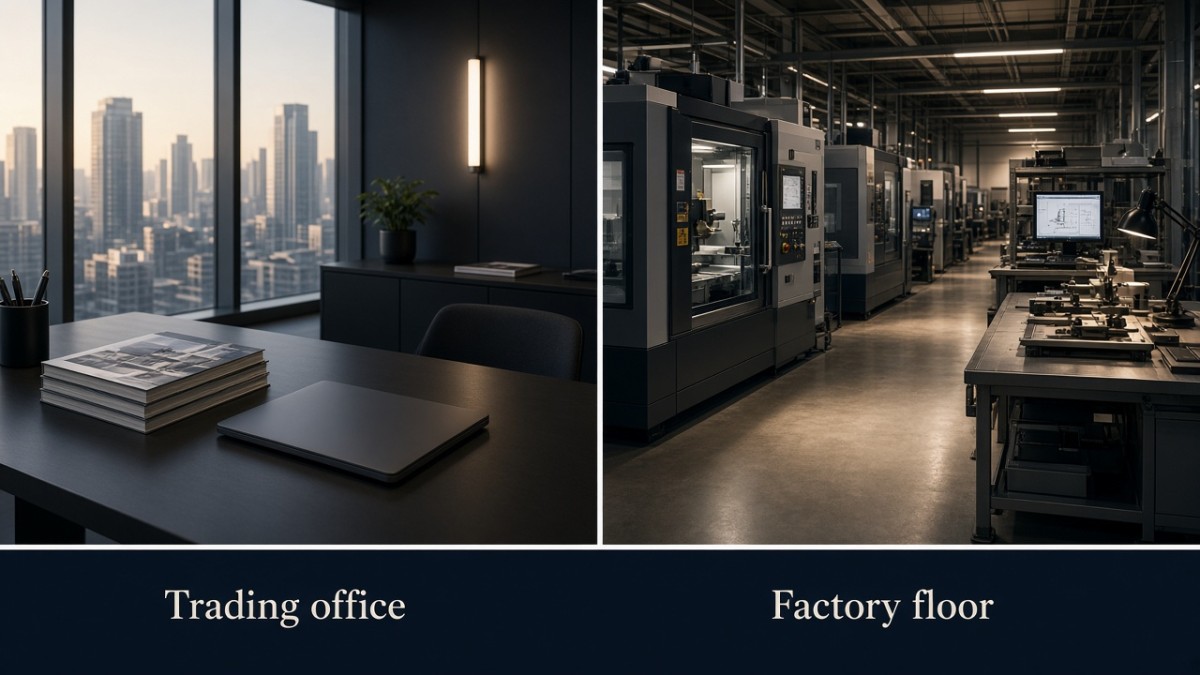
Ask questions that a trading company cannot answer without calling someone else
A factory conversation should produce specific answers about machining, assembly, testing, and lead time; a trader often has to relay those questions.
Useful questions include:
- Which processes are done in this facility, and which are outsourced?
- How many production lines and what kind of machining equipment are on the floor?
- Where is incoming-material inspection done, and what is checked before assembly?
- How is a finished lock tested, and is there a written record by batch or serial?
- Who engineers a private-label change, and where is the sample made?
- What happens when a destination-market buyer reports a defective unit?
You are not looking for a rehearsed slogan. You are looking for a person who can walk you to the process they just described. If every technical answer is deferred, you may be talking to a sales layer rather than to the manufacturer.
Hobere’s public factory profile, which a visitor can use as a starting checklist, is a 20,000-square-meter facility, 70+ employees, six production lines, 100+ CNC machines, and a capacity of 50,000+ sets per month. Those figures describe scale. They do not replace a walk through the actual lines, and they should not be padded with invented staff counts, patent totals, or output records.
Inspect production, CNC, assembly, and quality control as one system
A credible smart-lock factory can show how a metal housing is machined or finished, how electronics are assembled, how the lock is tested, and how a finished unit is identified.
On a visit, ask to see:
- Machining or finishing: CNC or other equipment used for lock housings and precision parts
- Assembly lines: mechanical assembly, electronics, and final assembly, and how they are separated
- Testing: function tests, any weather or durability tests that are actually performed, and how failures are handled
- Traceability: batch or serial identification, and whether a complaint can be traced backward
- Packing and export preparation: languages, plugs or cables, manuals, and how a private-label carton is controlled
- Stock and materials: not as a promise of instant volume, but as evidence that the process is real
CNC capability matters for models that use precision-machined housings, but a machine count is only useful if the machines are in service and tied to the products you intend to buy. Current featured models include H8Pro, D3, H6Pro-F, Q9-F, A1, A2, A3, A4, and Q10. Ask which of those, or which configuration, would run on the lines you are being shown.
Quality control should have a place, a written instruction, and a record—not only a banner on the wall. If a factory claims a test, ask to see the method and a recent record for a comparable model. Do not accept a photograph of a certificate for a different company or a different product as proof for the unit you are buying.
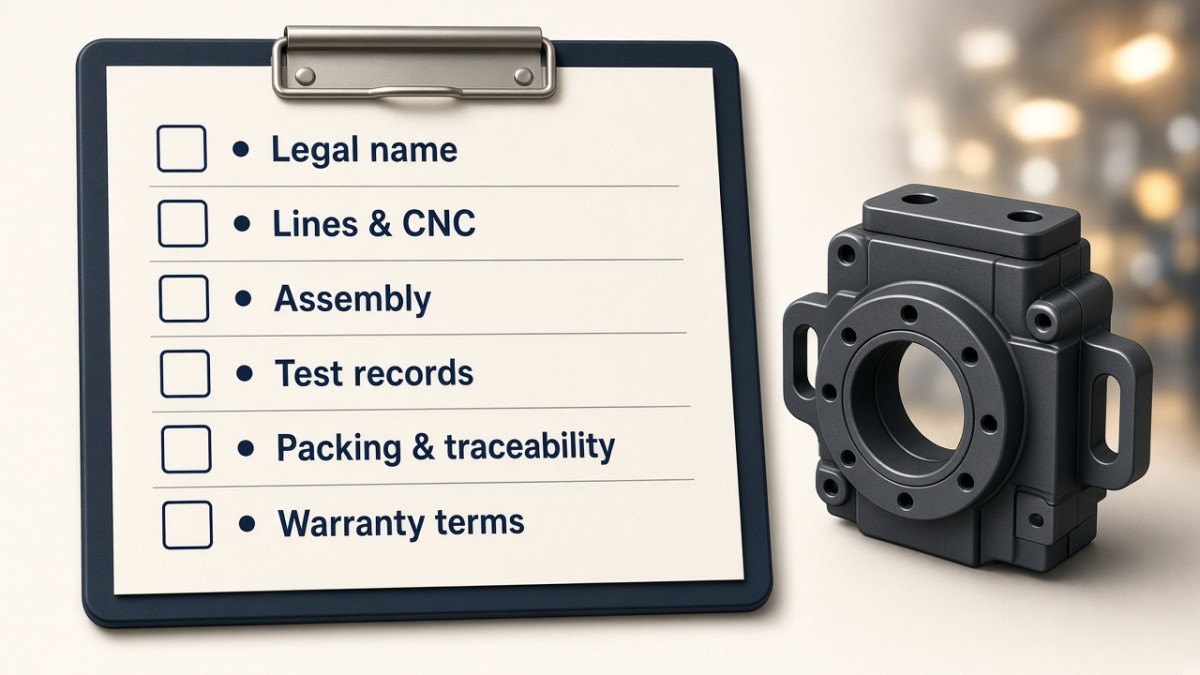
Treat sampling, MOQ, warranty, and after-sales as part of the same vetting file
Commercial terms are part of manufacturer vetting because they reveal whether the factory can support an overseas buyer after the first shipment.
Hobere’s public ODM terms are: a sample in five days; orders within 100 sets in 15 days; an MOQ of 500 sets with a 45-day lead time; and OEM terms negotiated separately. Those figures are the public baseline. If your project needs a different timetable or a structural change, ask for a written exception rather than assuming the baseline still applies. The practical sampling and lead-time questions are expanded in Private-Label Smart Locks: ODM Sampling, MOQ, and Lead Time.
The public overseas warranty is a two-year free warranty on the complete unit; shipping is not included. Do not import domestic dealer practices, such as storefront subsidies or free door-to-door replacement promotions, into an export contract. Spare-part SKUs and a detailed RMA workflow are not published as official facts in this series; if you need them, ask during the visit and record the answer.
App and software support should also be named accurately during vetting. Tuya is supported on A1, A2, A3, A4, D3, Q10, H6Pro-F, and Q9-F. H8Pro uses Dingding Smart (叮叮智能), which is not DingTalk. Matter over Wi-Fi is an expandable option, not a standard feature. Hotel lock and PMS integration are outside the scope of this phase and should not be used as a vetting shortcut.
A practical visit agenda
A half-day or one-day visit is enough to cover the essential points if the agenda is written in advance.
A workable agenda is:
- Legal and commercial: license, contracting entity, quotation format, warranty wording
- Factory overview: area, headcount, lines, and CNC, checked against the public profile
- Process walk: machining, assembly, testing, packing
- Product confirmation: the featured models or configurations you actually intend to buy
- Quality records: a recent test or inspection record, and how a defect would be traced
- ODM and export: sample timing, MOQ, lead time, branding, manual language
- After-sales: warranty scope, what shipping is not included, and the contact path
Take photographs only where the factory allows it, and take notes on names and processes rather than collecting souvenirs from a showroom. If you cannot visit in person, a live video walk through the same points is better than a pre-edited promotional film, but it is still a weaker substitute than being on the floor.
Questions worth closing in writing
Which legal entity will appear on the contract, invoice, and warranty?
For Hobere, use Zhongshan Hongtu Intelligent Technology Co., Ltd.
Which processes are in this factory, and which are outsourced?
Get a process list, not a general claim that “we manufacture.”
Can we see a test or inspection record for a comparable lock?
A record is more useful than a corridor display of trophies.
Does any certificate apply to the Zhongshan company or to the exact model we are buying?
Do not assign the Shenzhen Hongbohui ISO 9001 certificate to the Zhongshan entity, and do not extend model-specific certificates to unlisted featured models.
What are the sample, MOQ, lead-time, and warranty terms in writing?
Start from the public figures in this article and record any agreed change.
Talk with Hobere about a factory review
Hobere welcomes overseas buyers who want to review the Zhongshan factory against a project or private-label plan. Write to hongtusmartlock@hobere.com or use the Contact page, and include the models you are considering and whether you want a visit, a sample, or a quotation.
Hobere

Thank you very much for writing to us. Please leave your message and contact information, we will reply to you within 24 hours.