
A workable overseas smart-lock specification is a written decision on the door, the climate, the unlock methods, the network behavior, the power plan, and the after-sales terms—not a model name copied from a catalog page.
Buyers who skip that work usually discover the gaps after installation: a fingerprint sensor that fails in rain, an app that cannot issue a code when Wi-Fi is down, a battery that dies with no agreed emergency-power method, or a warranty that does not include shipping. This article is a practical specification sequence for importers, project buyers, and anyone vetting a China factory for residential, apartment, or commercial use. Hotel lock systems and property-management-system (PMS) integration are outside the scope of this series.
The Hobere brand is manufactured by Zhongshan Hongtu Intelligent Technology Co., Ltd. (中山弘途智能科技有限公司). Current featured models in this series are H8Pro, D3, H6Pro-F, Q9-F, A1, A2, A3, A4, and Q10. Use those names in the specification, then confirm the exact configuration in writing before you place a quantity order.
Start with the door, the users, and the climate
The first line of a specification should describe the door and the people who will use it, because those constraints eliminate more models than any app feature list.
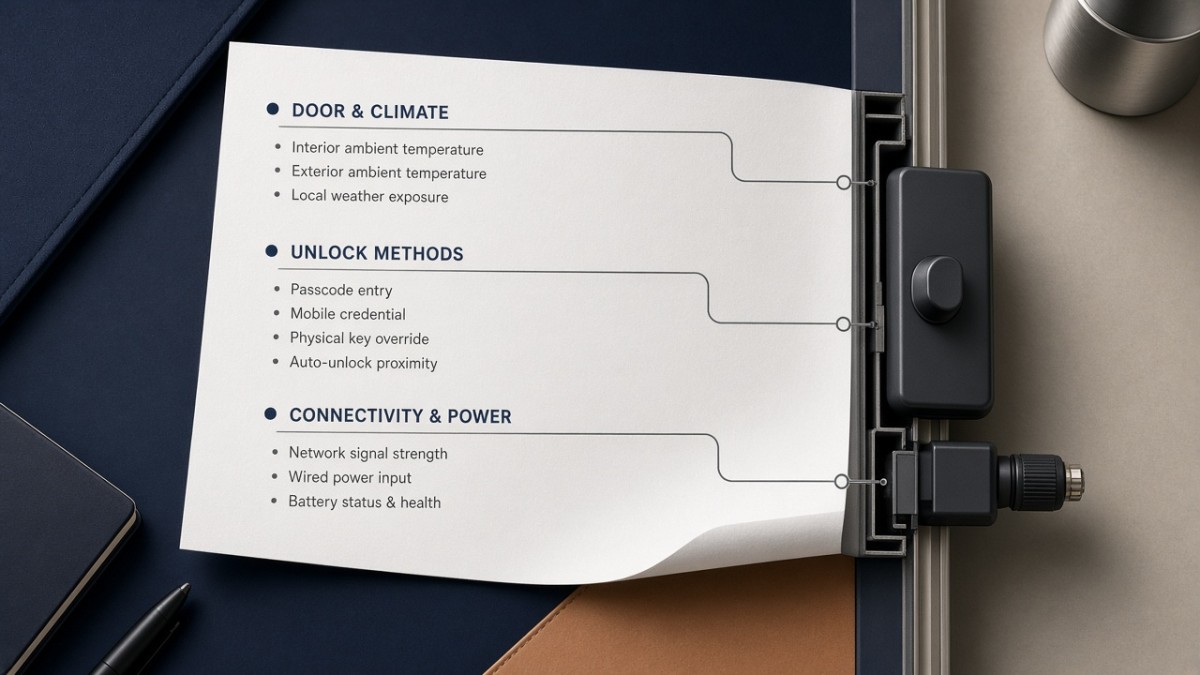
Record door material (wood, security door, stainless steel, or another construction), thickness, handing, existing hole pattern, and whether the opening is indoor, sheltered, fully outdoor, or coastal. Then record who will unlock the door: residents, children, delivery staff, property managers, or a mix. A family entrance, a rented apartment, and a small commercial back door place very different demands on credential types, temporary access, and account administration.
If the door faces weather, treat environment as a specification item, not a later accessory. Rain, dust, and salt air do not fail in the same way, and a lock described as suitable for outdoor use is not automatically proven for a seafront project. Ask for the test method and any rating that applies to the exact model.
Installation details belong in the same file. Wooden doors, security doors, and stainless-steel doors differ in reinforcement, backset, and hole preparation. A model that is described as compatible with those door types still needs a site check before the order is finalized. For the installation questions that should sit next to the product choice, see Installing Smart Locks on Wooden, Security, and Stainless Doors.
Specify unlock methods as failure modes, not as a feature count
A method belongs in the specification only if it still works for the actual users in the actual conditions.
Fingerprint sensors are familiar and fast when fingers are clean and the sensor is dry. They are also the method most likely to fail with wet, dry, worn, or cold skin, or when users wear gloves. Face recognition can be convenient at a residential entrance, but lighting, height, and face coverings change the result. Palm-vein recognition reads vascular patterns in the palm and is often considered when fingerprint reliability is a known problem; it still needs a clear enrollment process and a fallback method.
Projects should require at least two reliable local methods plus a mechanical key or equivalent physical override. “Seven ways to unlockb�� is not a specification. “Fingerprint and palm vein enrolled for residents, card or code for staff, mechanical key held by the property manager” is a specification.
Several current Hobere featured models combine biometric options with card, password, app, and key access. Confirm the exact method set, credential capacity, and enrollment process on the model you intend to order. Product pages for A1 and A2 are not reliably live, so confirm those models with the factory rather than depending on a short product URL.
Treat connectivity as a fallback design, not as the primary unlock path
The lock must still open when the network drops, because overseas projects cannot assume continuous Wi-Fi, stable mobile data, or a correctly configured gateway.
For current Hobere models, Tuya is supported on A1, A2, A3, A4, D3, Q10, H6Pro-F, and Q9-F. H8Pro uses Dingding Smart (叮叮智能). That app name is not DingTalk, and the two should not be confused in a purchase order or an IT review. Matter over Wi-Fi is an expandable option on Hobere products; it is not a standard, included feature and should not be written into a bid as if it ships by default.
If a project needs a different app stack, ask the factory in writing. TTLock support on models such as A3 and A4 should be treated as something to confirm, not as a standard or already-promised optional feature.
Write the connectivity section of the specification as three layers: local unlock that works with no network; app features that may work when the phone and lock can reach their service; and any optional protocol, such as Matter over Wi-Fi, that will be evaluated only if the project requires it. Do not assume a particular cloud region or data-residency arrangement. If that issue matters to the project, ask and get the answer in writing.
Put power and emergency access into the same document
Battery failure is a lockout risk, not only a maintenance inconvenience, and it should be specified before a quantity is approved.
Ask how the lock is powered, how users are warned of low battery, and what emergency power method exists on the exact model. D3 materials describe an external emergency power path, including phone reverse charging in some materials and a Type-C port that can be used with a power bank on the current product page. For other featured models, do not assume the same port or method; confirm the interface on the model you are buying and state it in the purchase documents.
Also specify who holds mechanical keys and how a lockout will be handled after hours. Camera-equipped locks and frequent app connections can change battery behavior, so a project with visual locks should treat power as a usage question, not only a capacity number.
Decide automatic operation and privacy as user-flow requirements
Fully automatic and handle-operated (semi-automatic) designs change how people exit, how the door works with a closer, and how the lock feels when power is low. That choice is a user-flow requirement, not a catalog preference. Households with children or older residents, doors with strong closers, and commercial exits that must be obvious under stress all need a clear statement of whether the user turns a handle after authentication or whether the lock completes the opening motion on its own. Confirm the behavior on the exact model, including how the door is opened from inside.
If the lock includes a camera, cat-eye, or indoor screen, the specification should also say who can view the image, where is stored, and whether audio or cloud recording is required—or prohibited. Visual locks are specified as much for the camera and display as for the bolt. Apartment and commercial buyers should ask the same privacy questions they would ask of any device that can capture a doorway, especially when staff or tenants change.
Add factory capability and warranty terms before you approve a quantity
Factory and warranty terms belong in the specification because they affect delivery, spare planning, and what happens when a unit fails in the destination market.
Hobere’s public factory profile is a 20,000-square-meter facility, 70+ employees, six production lines, 100+ CNC machines, and a capacity of 50,000+ sets per month. Those figures are useful for a first filter, but they do not replace a visit or a documented quality plan. For the questions that distinguish a factory from a trading company, see How to Vet a Smart Lock Manufacturer in China: Factory vs Trading Company.
The public overseas warranty is a two-year free warranty on the complete unit; shipping is not included. Do not import domestic dealer practices—such as storefront or door-to-door subsidies—into an export contract. If you need sample, private-label, or quantity timing, the public ODM terms are: a sample in five days; orders within 100 sets in 15 days; an MOQ of 500 sets with a 45-day lead time; and OEM terms negotiated separately.
What to put in the RFQ
A complete request for quotation is a short, specific document, not a request for “your best smart lock.”
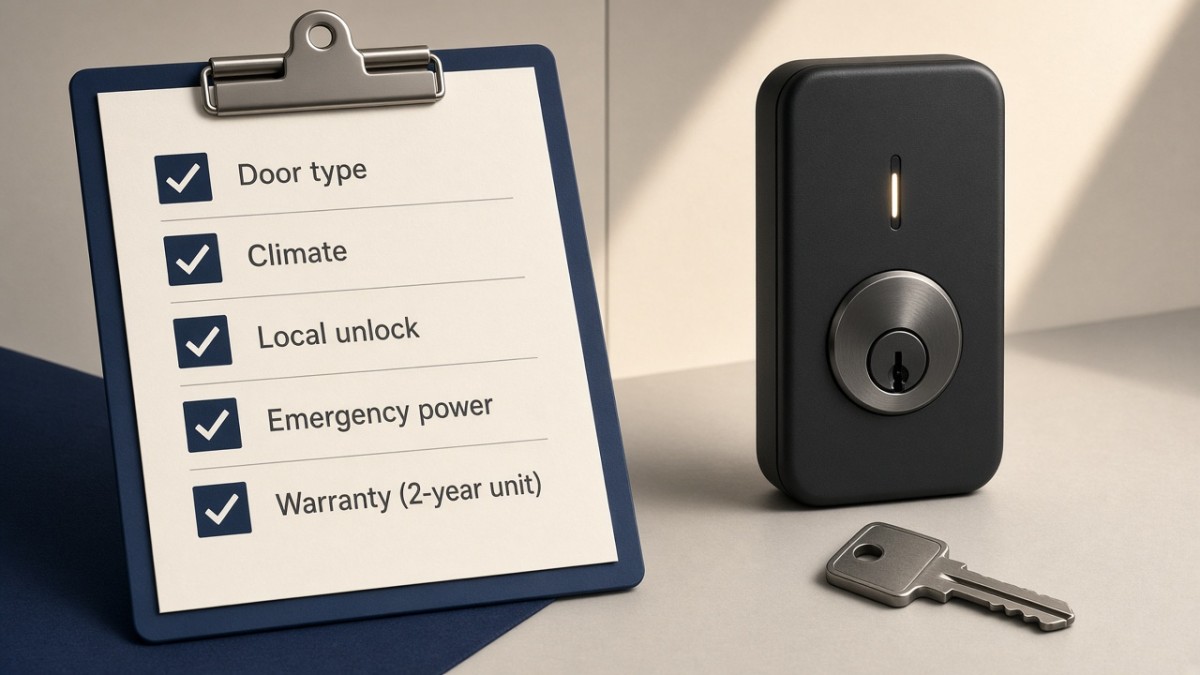
Include at least the following items:
- Door material, thickness, handing, and a photo or drawing of the existing preparation
- Indoor, outdoor, or coastal exposure, and any test evidence you will vequire
- Required local unlock methods and who will use each method
- Required app platform, and a statement that Matter over Wi-Fi is optional only if needed
- Power type, low-battery warning, and the emergency-power interface to be confirmed on the model
- Whether a camera, cat-eye, or indoor screen is required, and any privacy limits
- Quantity, packing, branding, and language requirements
- Warranty language that matches the public two-year unit warranty and states that shipping is not included
- Destination country requirements that the buyer will verify, without assuming a certificate covers a model that is not listed on it
Current featured models can be named as a starting shortlist. Live product pages exist for H8Pro, D3, H6Pro-F, Q9-F, A3, A4, and Q10. The D3 page is live even though its URL still uses an older “Simple Style” slug; refer to the product as D3. Do not treat A1 or A2 short URLs as primary links until those pages are reliably published.
Questions worth closing in writing
A short question list keeps unverified claims out of the purchase order.
Which unlock methods are confirmed on the exact configuration we are ordering?
Feature lists vary by model and by software build. Name the methods and ask the factory to confirm them on the quotation.
What still works if Wi-Fi, mobile data, or the app service is unavailable?
The acceptable answer is a clear list of local methods, plus a mechanical override plan.
What emergency power interface is on this model?
D3 has documented emergency-power materials. Other models should be confirmed, not assumed from a neighboring product page.
Is Matter over Wi-Fi included?
No. It is an expandable option and should be quoted only if the project asks for it.
Which legal name and warranty terms will appear on the documents?
Use Zhongshan Hongtu Intelligent Technology Co., Ltd. when a legal name is required, and keep the two-year complete-unit warranty, excluding shipping, in visible contract text.
Talk with Hobere about a project specification
Hobere can help overseas buyers turn a door survey and a use case into a written specification, then confirm the matching model and configuration. Send the door details, environment, required unlock methods, and quantity range to hongtusmartlock@hobere.com, or use the Contact page.
Hobere

Thank you very much for writing to us. Please leave your message and contact information, we will reply to you within 24 hours.