
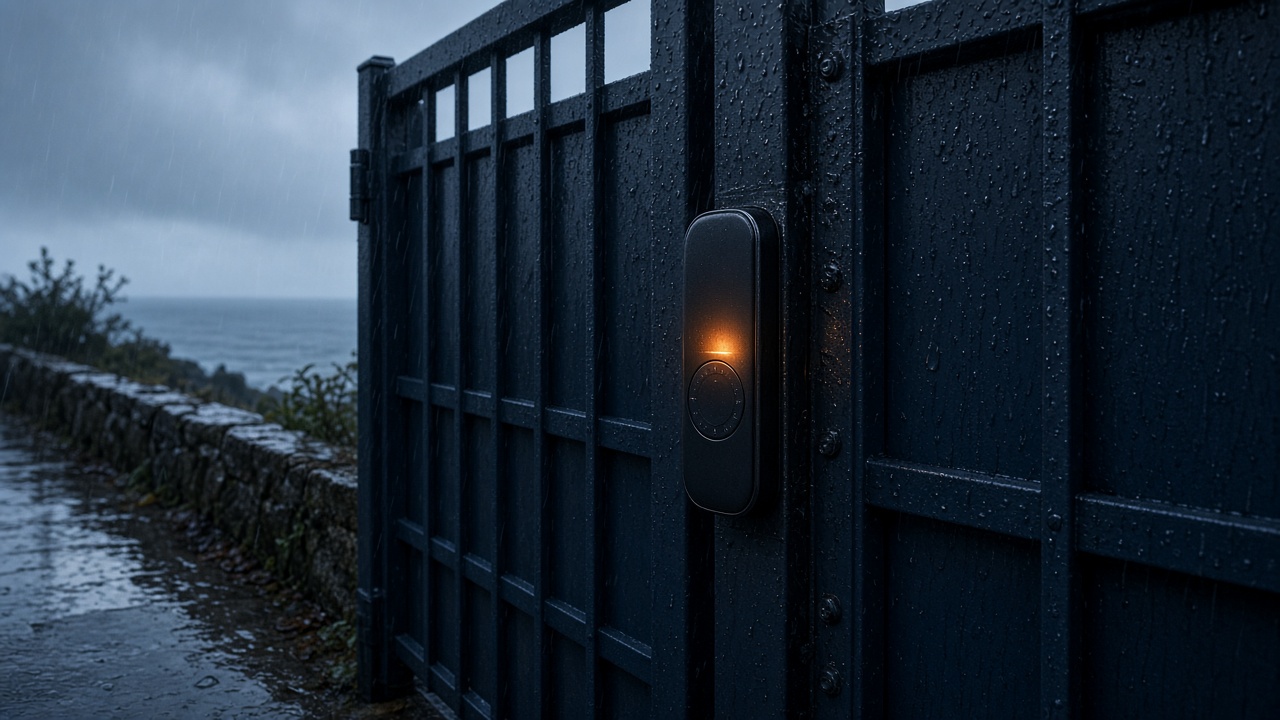
A smart lock that can handle rain is not automatically proven for a coastal site, because salt spray is a corrosion problem as well as a water-ingress problem.
Overseas buyers often write "waterproof" into an RFQ and stop there. That wording is too loose for an exposed gate, a villa entrance with no porch, or a door within reach of sea air. Water can penetrate seams, button membranes, sensor windows, and cable openings. Salt can also attack coatings, fasteners, contacts, and metal housings after the surface looks dry. The two failure modes can appear on the same door, but they are not demonstrated by the same claim. This article explains how to specify outdoor and coastal locks without inventing a rating the factory has not provided.
It is part of the project-specification sequence in How to Specify a Smart Lock for Overseas Residential, Apartment, and Commercial Projects. Installation measurements and door materials are covered in Installing Smart Locks on Wooden, Security, and Stainless Doors.
Describe the exposure in the specification, not with a single adjective
The environmental line of a specification should say whether the door is indoor, sheltered, fully exposed to rain, or coastal, because each condition asks for different evidence.
A useful way to classify the opening is:
- Indoor or well-sheltered: water and salt are not the primary risks; wear, door fit, and user methods still are
- Rain-exposed but inland: the lock may see wind-driven rain, dust, and temperature swings
- Coastal or sea-adjacent: the lock may see salt-laden air and deposits even when it is not raining
- Opening direction and porch: an outward-opening door with no canopy is a harder case than an inward door under a roof
Photographs of the entrance, including the overhead shelter and the direction the door faces, belong in the RFQ. A factory can only discuss the right model if it can see the exposure.
Do not use "outdoor lock" as a synonym for "coastal lock." The first is a placement. The second is a corrosion requirement.
Rain resistance is about keeping water out of the electronics and the mechanical path
Rain performance depends on housing design, seals, sensor placement, and installation quality, not on a word in a product title.
Water typically causes trouble at fingerprint sensors, button or touch panels, speaker and microphone openings, camera or cat-eye windows, seams between front and rear assemblies, and any cable or emergency-power opening. A wet fingerprint is also a user-method problem: even if the housing keeps water out, the sensor may reject a wet finger. Outdoor projects should therefore specify a second local method, such as a card, password, or palm vein, rather than depending on fingerprint alone.
Current Hobere featured models that are positioned for outdoor or waterproof use include the H6Pro-F and the Q9-F. Those live pages are the right starting point for a rain-exposed shortlist. This series does not publish an IP rating for H6Pro-F or Q9-F. If you need a rating, ask for the test standard, the rating, and the test report that applies to the exact model-and write only what the report supports.
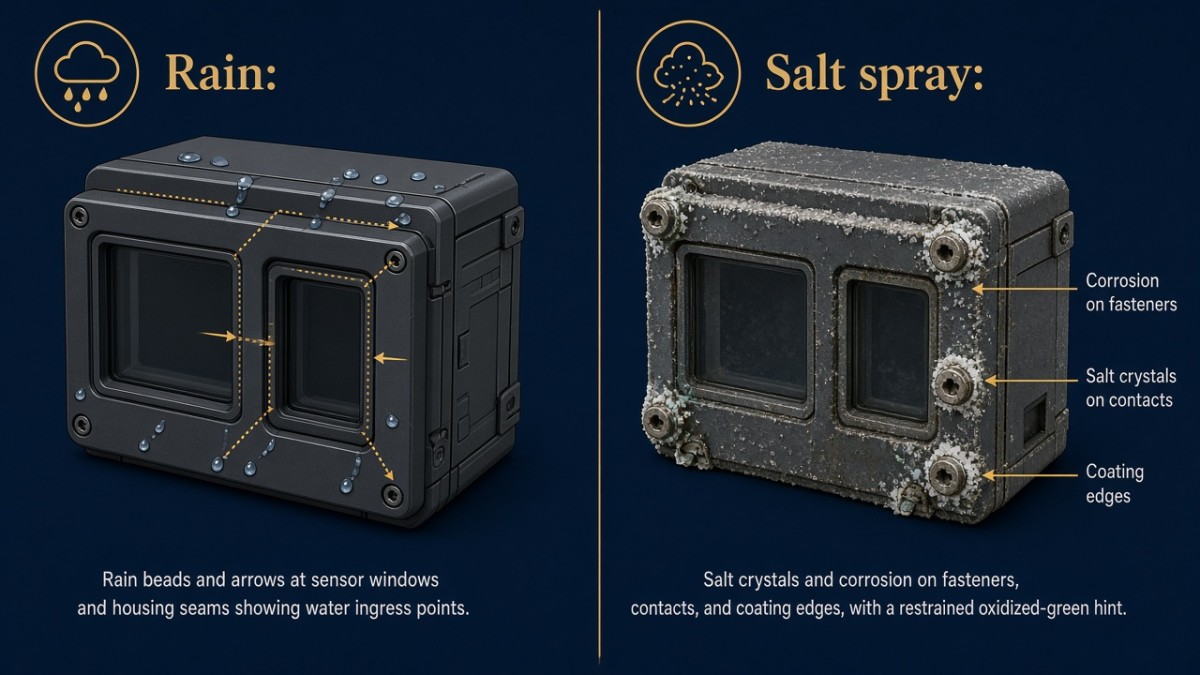
Installation can undo a well-designed housing. A gap around an embedded cassette, a poorly closed door, or an unsealed penetration will admit water that the product test never included. The installation survey should therefore include closer force, strike alignment, and how any cable is routed.
Salt spray is a materials and corrosion problem that must be evidenced separately
Coastal air leaves salt on surfaces and in crevices, so the relevant evidence is corrosion testing and material choice, not a rain demonstration alone.
Salt can dull coatings, corrode fasteners and springs, attack electrical contacts, and shorten the life of a metal housing that was adequate inland. A lock can remain "waterproof" in the sense that rain does not immediately enter the electronics, and still degrade in a seafront installation. That is why a coastal specification should ask for salt-spray or equivalent corrosion evidence on the exact model, including the test method and duration.
This series does not publish salt-spray hours for H6Pro-F, Q9-F, or any other featured model. Do not invent a number, and do not borrow a figure from an older or different model. Ask the factory what test, if any, has been performed, and decide whether that evidence is enough for the site. If the evidence is not available, treat coastal use as unconfirmed and either request a test, a material upgrade, or a different protection strategy, such as a deeper porch and a maintenance plan-none of which should be described as a substitute for evidence you do not have.
Other featured models, including H8Pro, D3, Q10, A1, A2, A3, and A4, should not be assumed to be outdoor or coastal locks unless the factory confirms that use for the exact configuration. Handle-style wooden-door locks in particular are often indoor specifications.
Maintenance and unlock methods are part of the environmental specification
A coastal or rain-exposed lock still needs a maintenance plan and local fallbacks, because deposits and wet sensors will occur even when the housing is sound.
Write down:
- How often the sensor windows, fingerprint surface, and seams should be cleaned
- Which local methods remain available if a wet or salty fingerprint is rejected
- How low-battery warnings will be noticed on an outdoor door
- Whether emergency power, if confirmed on that model, remains accessible without exposing a poorly sealed opening
- Who is responsible for checking seals after installation and after the first wet season
D3 has documented emergency-power materials; other models should be confirmed. Do not assume that an emergency port is equally protected on every outdoor unit. If the door is exposed, ask how that interface is capped or sealed.
App features do not solve weather. Tuya is supported on A1, A2, A3, A4, D3, Q10, H6Pro-F, and Q9-F; H8Pro uses Dingding Smart (叮叮智能), which is not DingTalk. A remote notice can tell a manager that a lock is offline or low on battery, but the lock must still operate locally in rain.
Certificates should also be handled carefully. Do not extend CE or EMC documentation that applies to other models onto H6Pro-F, Q9-F, or the rest of this featured list. If a destination market requires a particular mark, ask which models actually have it and request the documents.
What to put in the environmental section of an RFQ
A precise environmental section prevents a generic waterproof claim from becoming the entire technical answer.
Include:
- Exposure class: indoor, sheltered, rain-exposed, or coastal, with photos
- Distance from the sea or any other corrosive source, if known
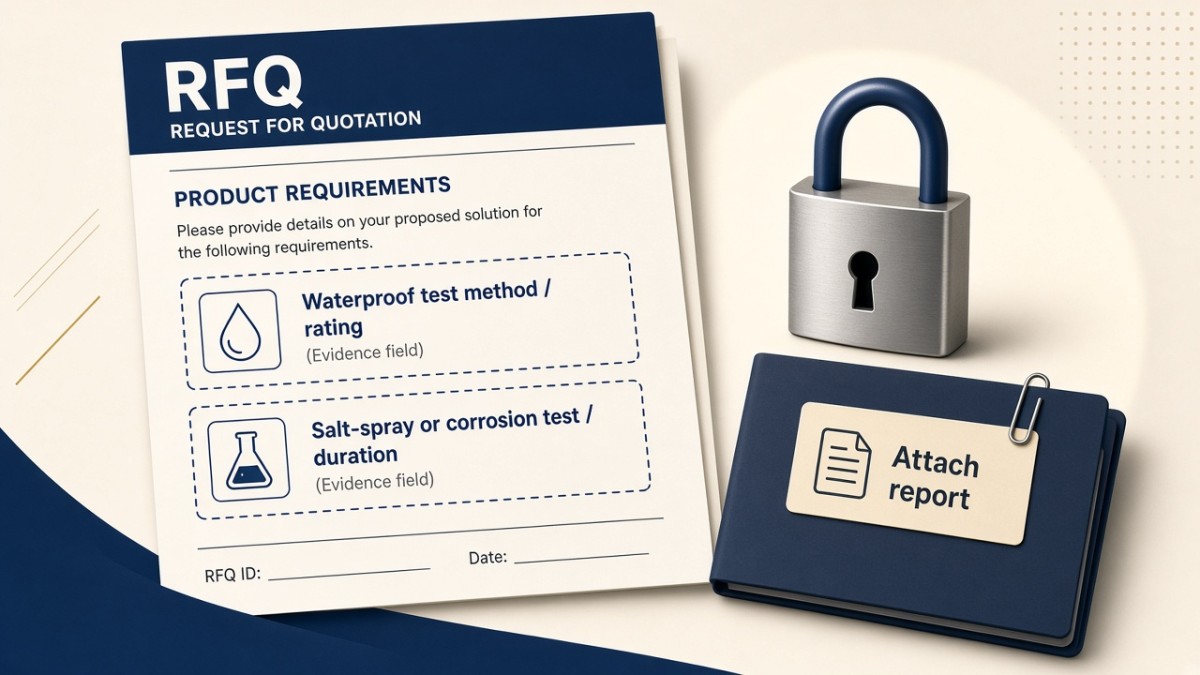
- Required evidence: waterproof test method and rating if you need one; salt-spray or corrosion test method and duration if the site is coastal
- A statement that no IP rating or salt-spray hour figure should be written into the order unless a report for that model is attached
- Secondary local unlock methods for wet-sensor conditions
- Installation sealing responsibilities
- Preferred shortlist, such as H6Pro-F or Q9-F for outdoor-positioned products, subject to confirmed evidence
H6Pro-F and Q9-F also include broader project features, such as biometric options and Tuya support, but those features do not replace the environmental evidence.
Questions worth closing in writing
What waterproof test, if any, has been performed on this exact model?
Ask for the standard and the result. Do not invent an IP code.
What corrosion or salt-spray test, if any, has been performed, and for how many hours?
If the factory cannot provide this for a coastal site, the risk remains open.
Is the quoted unit the same construction that was tested?
Coatings, gaskets, and assemblies can differ between versions.
How is the emergency-power interface, if present, protected from water?
Confirm both the interface and its cap or seal.
Who cleans and inspects the lock after handover?
Outdoor products still need a maintenance owner.
Talk with Hobere about outdoor and coastal specifications
Hobere can help you decide whether an outdoor-positioned featured model is a reasonable shortlist for a rain-exposed door, and can discuss what test evidence is available for the exact unit. Send entrance photos, location, and any required test methods to hongtusmartlock@hobere.com, or use the Contact page.
Hobere

Thank you very much for writing to us. Please leave your message and contact information, we will reply to you within 24 hours.