
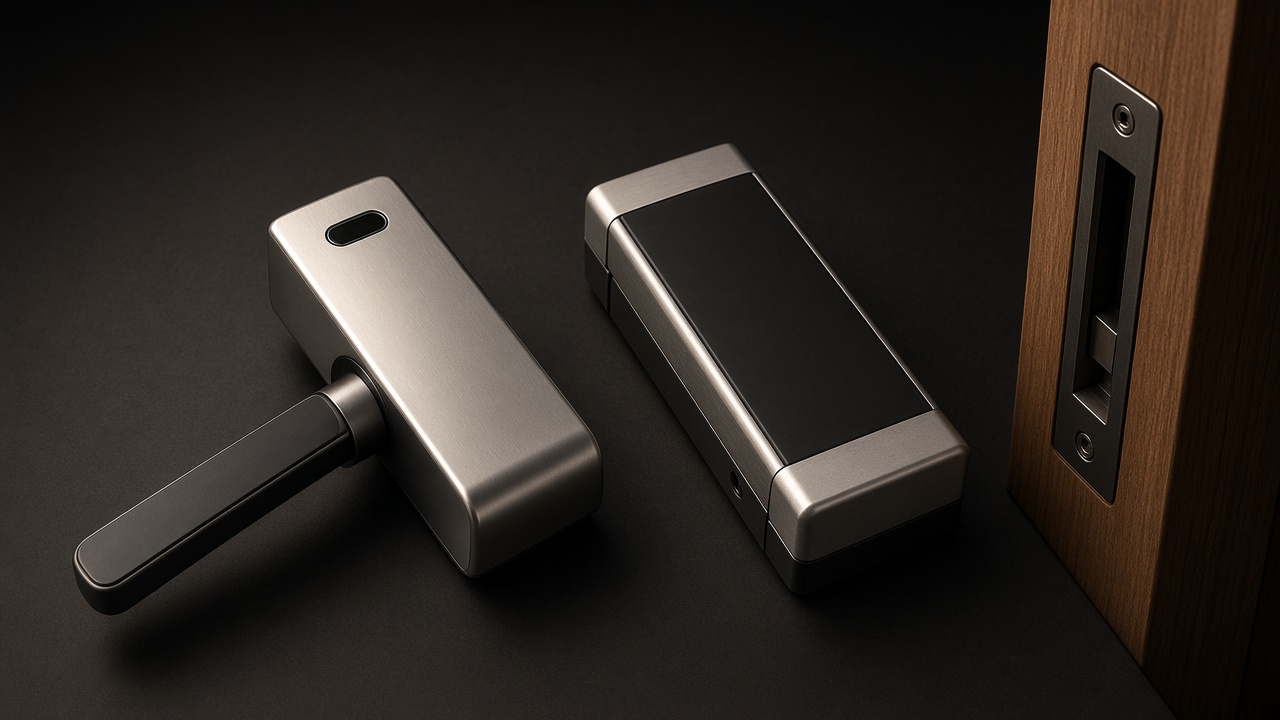
Fully automatic and semi-automatic smart locks are not a style choice: the presence or absence of a working handle changes how people exit, how the door works with a closer, and how the lock behaves when power is low.
Overseas buyers sometimes specify "fully automatic" because the phrase sounds more complete, or they specify a handle lock because it looks like a familiar lever set. Both approaches skip the actual decision. The question is how a resident, a child, a delivery person, or a staff member will open and close this door every day, including during a power problem or an evacuation. That user-flow decision belongs in the same specification as door type, unlock methods, and connectivity. For the rest of that sequence, see How to Specify a Smart Lock for Overseas Residential, Apartment, and Commercial Projects.
This article explains the distinction in practical terms. It does not assign a fully automatic or semi-automatic label to every current Hobere featured model, because that classification should be confirmed on the exact model and configuration being quoted.
The useful distinction is what the user must do after the lock authenticates
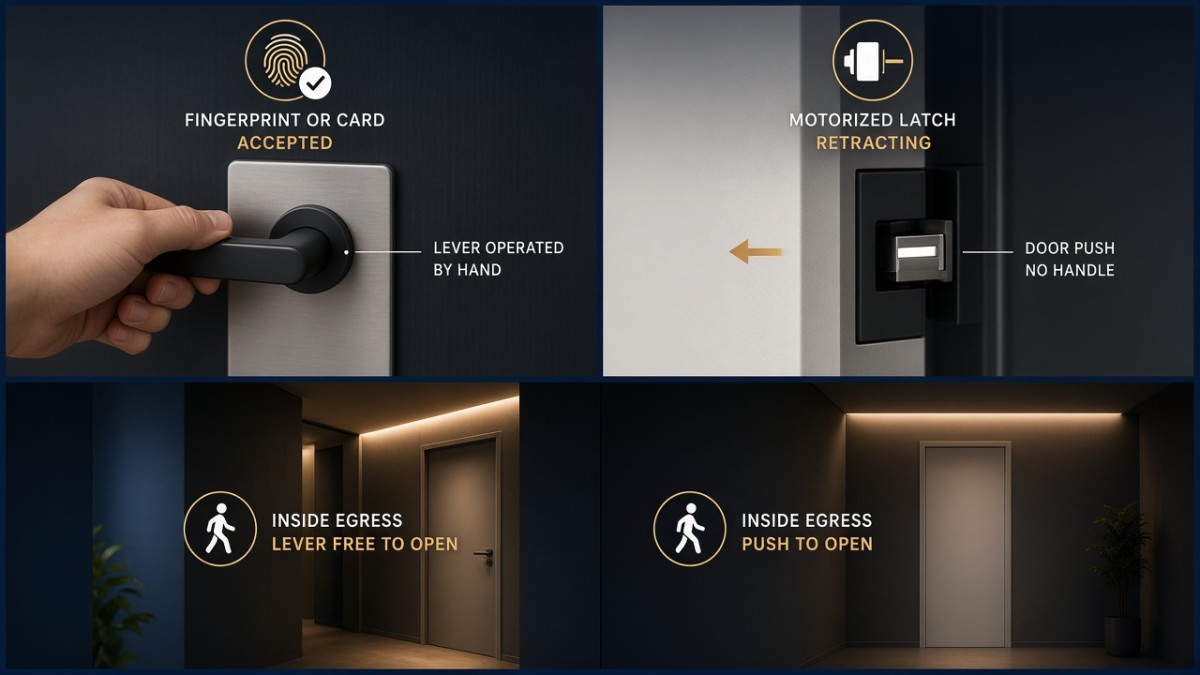
A semi-automatic (handle-operated) lock authenticates the user and then still requires a handle, knob, or similar mechanical action to open the door; a fully automatic lock uses a motor to complete more of the opening or closing sequence after authentication.
Those are working definitions for a specification, not marketing grades. In a handle-operated design, the electronic system typically releases or drives the latch enough for the user to operate the handle. In a more automatic design, the lock may retract the latch or bolt and, depending on the model and door hardware, allow the door to open with less or no handle action. Some products also support automatic relocking after the door closes. None of that should be assumed from a product family name.
The specification should therefore describe the required behavior in plain language:
- From outside: what the user does after face, palm, fingerprint, card, or code is accepted
- From inside: whether egress is a familiar handle motion, a button, a sensor, or a motorized action
- After the door closes: whether the lock relocks automatically, and after what delay
- If power is low: whether the inside exit method still feels obvious and mechanical
If a supplier answers only with "fully automatic," ask them to describe those four points for the quoted model.
A handle still matters when egress, habit, or door hardware must stay obvious
A handle remains the better choice when users must be able to exit by a familiar mechanical motion, or when the door's closer, thickness, or hardware makes a motorized open unreliable if it is not specified carefully.
Typical cases include:
- Households with children or older residents who already understand a lever handle
- Doors that must be opened quickly from the inside under stress
- Doors with strong closers, where the opening force and latch timing need to be checked together
- Sites that want the lock to look and feel like a conventional lever set, including many wooden interior or apartment doors
- Projects that want a mechanical motion available even if the user is unsure what the motor will do
Current Hobere handle-style featured models include the A3 and A4, which are positioned as keyless handle locks for wooden doors, with fingerprint, password, card, app, and mechanical key among the methods to confirm on the quotation. They are useful references when a project wants a handle-operated lock. Do not read hotel use into those pages; this series covers residential, apartment, and commercial access, not hotel or PMS systems.
A1 and A2 are also featured model names in this series, but their short product URLs are not reliably live. If you are considering those models, confirm handle type, door compatibility, and app platform with the factory rather than depending on a product link.
Automatic operation is a user-flow requirement, not a higher grade of lock
A more automatic lock is worth specifying only when the project has a clear reason for the motor to complete the opening or relocking motion, and when that behavior has been checked against the door hardware.
Reasons that can justify it include users carrying packages, a desire to reduce handle use at a main entrance, or a consistent auto-lock requirement after the door closes. Those reasons still need a site check. A heavy door, a misaligned latch, a closer that slams, or a frame that is not square can make a motorized sequence feel slow or incomplete. Automatic operation does not remove the need for a mechanical override or a confirmed emergency-power plan.
Because this series does not publish a model-by-model automatic classification for H8Pro, D3, H6Pro-F, Q9-F, or Q10, treat those products as a shortlist to discuss with the factory. Ask for the outside opening action, the inside exit action, and whether auto-lock is delayed or immediate. Then write the confirmed behavior into the quotation.
Power and installation are part of the same decision. A motor that moves a latch more often can change battery planning, and the lock still has to fit the door material and preparation. For door-material and site-survey questions, see Installing Smart Locks on Wooden, Security, and Stainless Doors.
Match the lock's motion to the people who will use the door
The right choice is the one that the actual users can operate without training every time they arrive, including guests who will never read a manual.
Walk through a few ordinary scenes in the specification meeting:
- A resident arriving with bags: does the door need to release and open, or is a handle acceptable?
- A child leaving in a hurry: is the inside exit method obvious?
- A cleaner or contractor who is not enrolled for biometrics: which local method will they use, and does the handle or motor change that process?
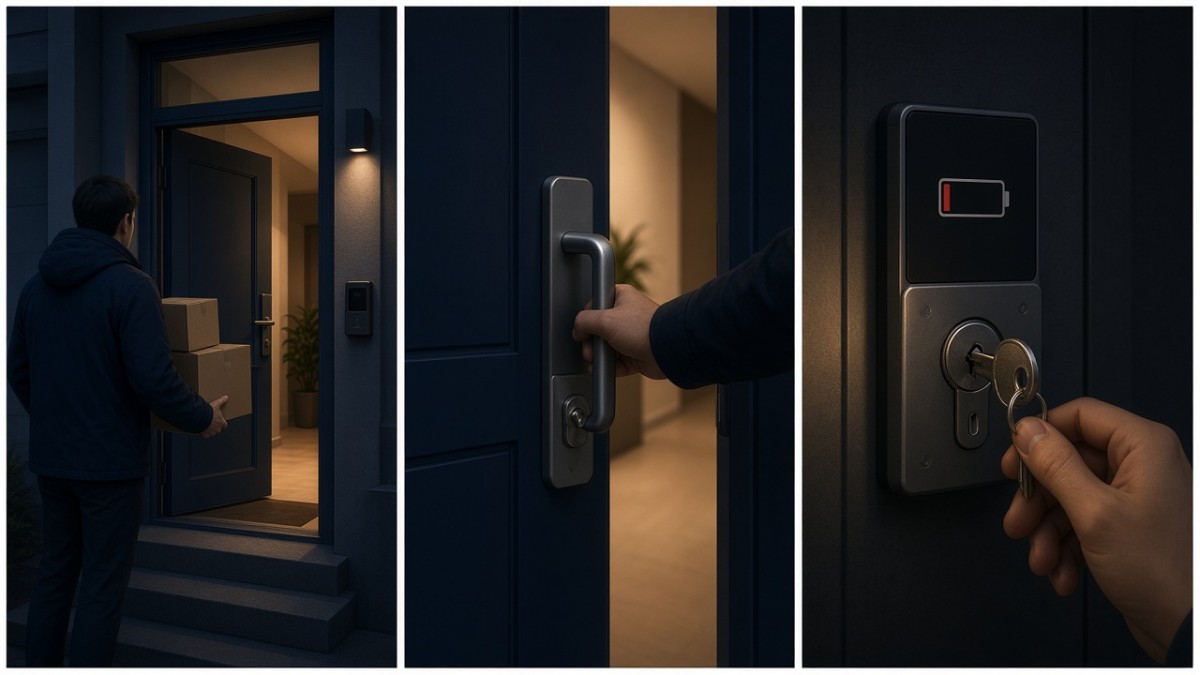
- A night lockout with a low battery: can someone still exit and, if needed, apply emergency power or a key?
Apartment and small commercial projects should also decide who teaches the method at handover. A handle-operated lock is usually easier to explain. A more automatic lock needs a short, written explanation of what the door will do after authentication and after it closes, so users do not pull a handle that is no longer the primary action-or fail to close the door firmly enough for auto-lock.
Connectivity does not settle this choice. Tuya is supported on A1, A2, A3, A4, D3, Q10, H6Pro-F, and Q9-F; H8Pro uses Dingding Smart (叮叮智能), which is not DingTalk. App features can show lock status or help issue a temporary code, but they do not change the mechanical motion at the door when the network is down.
What to write in the specification
The automatic-versus-handle section should be a behavior list, not a single adjective.
Include:
- Required outside action after authentication
- Required inside exit method, described in plain language
- Auto-lock behavior and any delay
- Door material, thickness, closer, and handing, because they affect motor and latch timing
- Confirmation of the mechanical key or equivalent override
- Confirmation of emergency power on the exact model (D3 has documented emergency-power materials; other models should be confirmed)
- The app platform, recorded separately from the mechanical behavior
Current featured models can be used as a shortlist, with A3 and A4 as live handle-style references. Confirm every other model's motion with the factory before you freeze the bill of quantities.
Questions worth closing in writing
After a successful fingerprint, face, card, or code, what exactly does the user do to open this door?
The answer should be a physical description, not the words "fully automatic."
How does a person exit from the inside if they are unfamiliar with the lock?
If the answer is not obvious, a handle-operated design may be the safer specification.
Does auto-lock depend on a complete door close, and has that been checked with the closer?
This is an installation question as much as a product question.
What happens to exit and entry when the battery is low?
Ask for the residual mechanical behavior, not only a capacity figure.
Are we specifying a handle because of the door, or because of habit?
Either reason can be valid, but it should be stated.
Talk with Hobere about handle and automatic operation
Hobere can help you confirm the opening and exit behavior on a specific featured model and match it to a door survey. Send photos of the door, closer, and preferred user flow to hongtusmartlock@hobere.com, or use the Contact page.
Hobere

Thank you very much for writing to us. Please leave your message and contact information, we will reply to you within 24 hours.