
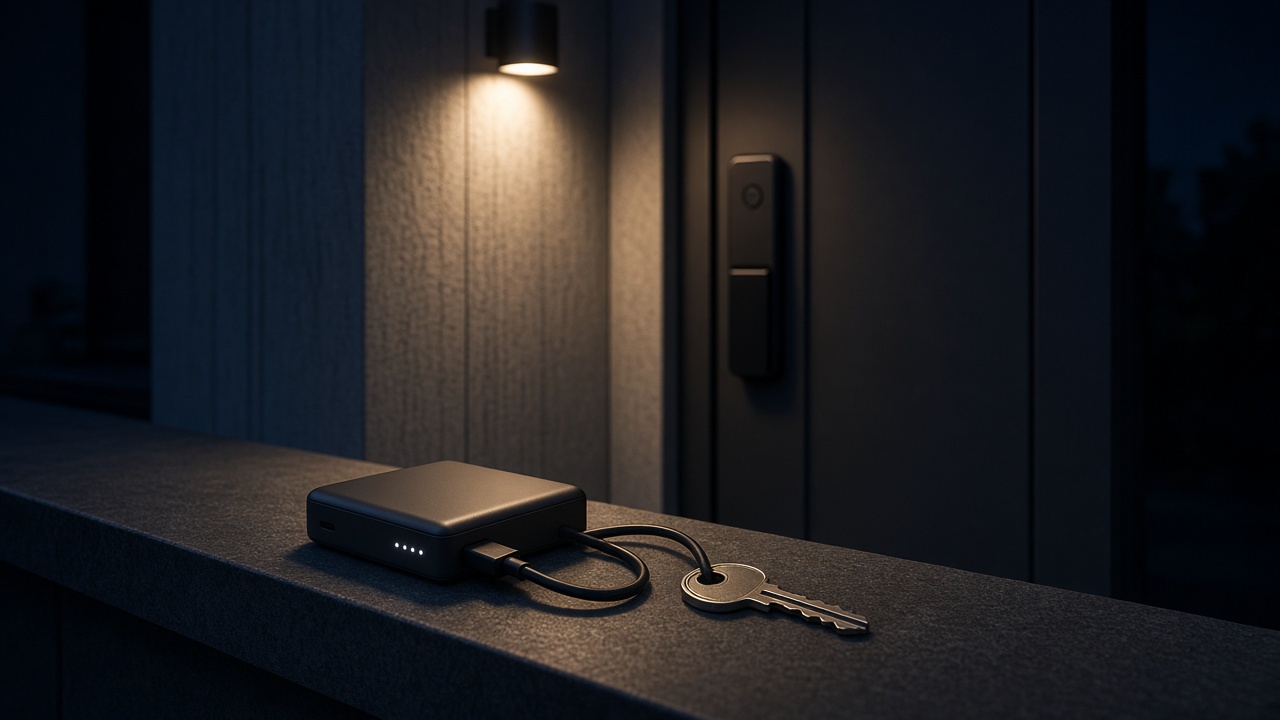
A drained smart-lock battery is a lockout risk if emergency power and a mechanical override are not specified before the lock is installed.
Overseas project buyers often treat battery capacity as a comfort figure and leave the rest to the user manual. That is not enough for a residential entrance, an apartment handover, or a commercial door that must still open after hours. Batteries age, cold weather shortens runtime, cameras and frequent network use can change consumption, and a low-battery notice that arrives only through an app is useless if the network is already down. The specification should therefore say how the lock is powered, how users are warned, what emergency power interface exists on the exact model, and who holds the mechanical key.
This article sits inside the broader project-specification sequence in How to Specify a Smart Lock for Overseas Residential, Apartment, and Commercial Projects. It does not invent runtime hours, spare-part SKUs, or a published RMA process.
Battery failure is usually a predictable maintenance event, not a sudden electronic defect
Most field lockouts begin with a battery that was not replaced in time, used in harder conditions than expected, or drained faster because the lock was doing more than opening a bolt.
Common contributors include:
- High daily traffic, which means more motor and sensor activity
- Cold outdoor installations, which reduce effective battery performance
- Visual locks with screens, cameras, or frequent live view
- Network features that keep the lock or gateway more active
- Users who ignore on-lock warnings because they expect the app to tell them first
Current Hobere featured models include both rechargeable-pack designs and handle-style locks commonly powered by replaceable cells, but the exact power arrangement must be confirmed on the model being ordered. Product pages may list a capacity figure for a given model; that figure is not a sitewide runtime guarantee and should not be copied from one model onto another. Ask how the pack or cells are replaced or recharged, and how long a standard maintenance interval is expected under the project's actual use-then treat the factory's answer as a planning input, not as a promised number in this article.
A power plan also has to work for the people who will service the lock. If a rechargeable pack can only be changed by a trained installer, the project needs a service arrangement. If the lock uses user-replaceable cells, the project needs a spare-cell policy and a clear warning method that does not depend on a single person checking an app.
Low-battery warnings should work at the door, not only in an app
A warning that exists only as a phone notification is not a complete warning, because notifications depend on the same network path that may already be unreliable.
Ask the factory, for the exact model:
- Whether the lock gives an on-device indication, such as a voice prompt, tone, or display message, when the battery is low
- Whether the app can also send a notice, and which app that is
- Whether the lock begins to refuse some features, such as remote functions, before it refuses local unlock
H8Pro uses Dingding Smart (叮叮智能), which is not DingTalk. Tuya is supported on A1, A2, A3, A4, D3, Q10, H6Pro-F, and Q9-F. An app notice can be useful for a property manager, but the on-door warning is the one that still matters if Wi-Fi is down. Network-dependent features and offline unlock are covered in more detail in Tuya, TTLock, Wi-Fi, and Offline Unlock: What Still Works When the Network Drops.
Do not assume a published number of years for app or firmware support. If a project needs that commitment, ask for it in writing.
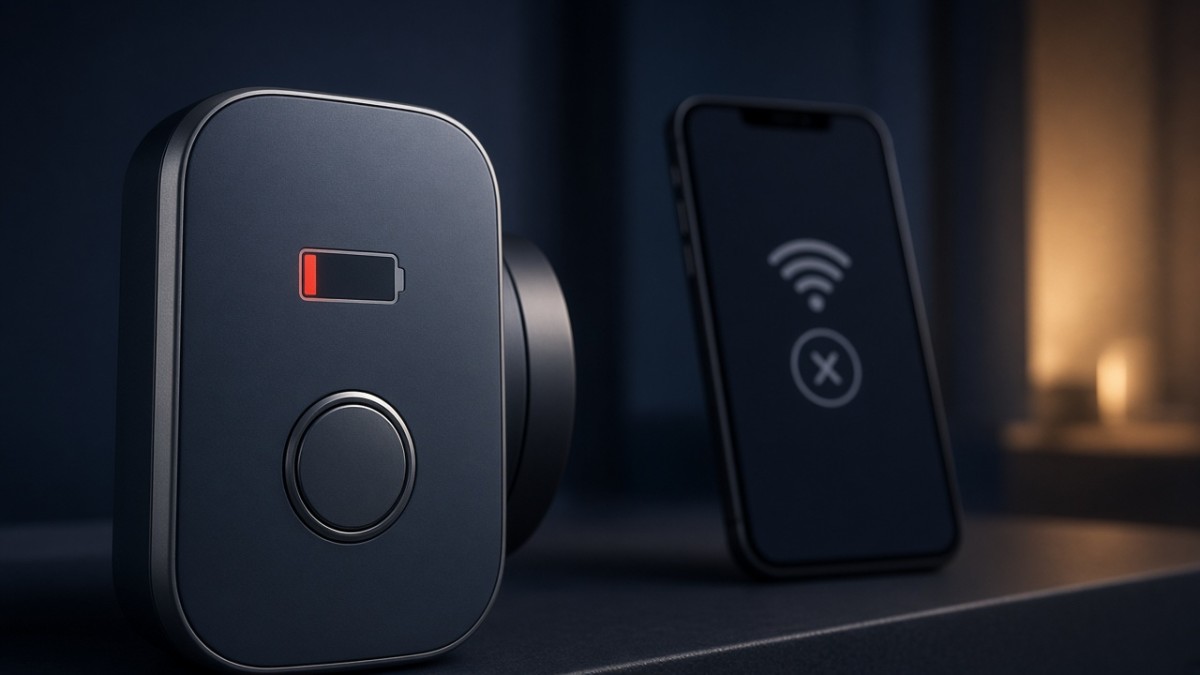
Emergency power must be confirmed on the exact model
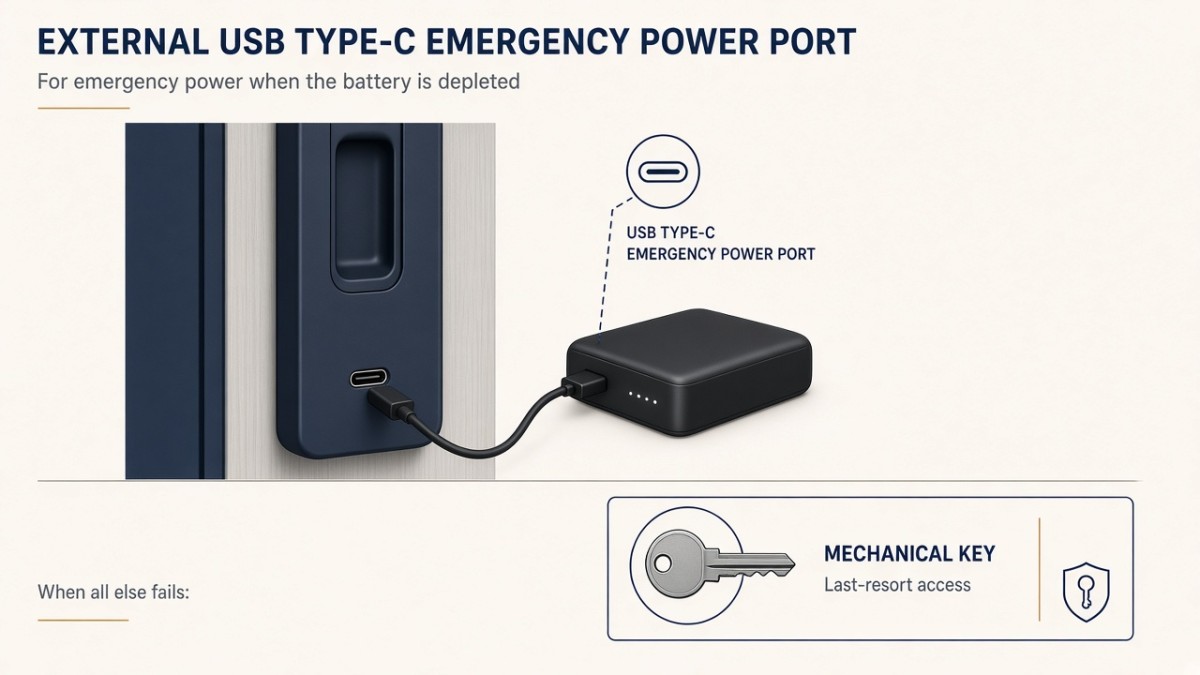
An external emergency power port matters because it gives a user a way to energize the lock long enough to authenticate, but the interface is not something to assume across a catalog.
Among current featured models, D3 materials describe an external emergency power path. Some D3 materials mention phone reverse charging, and the current D3 product page describes a Type-C port that can be used with a power bank. Refer to the product as D3 even though the live URL still uses an older "Simple Style" slug. Review the D3 product page, then confirm the exact interface and method on the unit you intend to order.
For other featured models-including H8Pro, H6Pro-F, Q9-F, Q10, A1, A2, A3, and A4-do not treat an emergency port as confirmed in this series, even if a neighboring page describes one. Product copy can change, and the port type (Type-C, USB-A, or another interface) and the accepted power method (power bank, phone reverse charging, or a dedicated cable) can differ. The specification should say: "Confirm the emergency-power interface on this model, including connector type and accepted power source, and include that confirmation in the quotation."
A usable emergency-power plan also needs a physical object at the site: a charged power bank, a known cable, or a phone that can actually supply power if that method is confirmed. A port with no agreed tool is not a plan.
Mechanical keys remain part of the power-failure plan
A mechanical key is the last local override when the battery is dead and emergency power is not available, so key custody has to be specified with the same care as the electronic methods.
Decide who holds spare keys, where they are stored, and how a lockout after hours is handled. In an apartment or commercial project, that is an operations decision as much as a hardware decision. A key that no one can find at midnight is not a fallback.
Also confirm how the door is opened from the inside when power is low. Handle-operated models and fully automatic models can feel different to a user in a hurry. The power specification should not be separated from the exit-path specification.
Warranty does not replace this planning. Hobere's public overseas warranty is a two-year free warranty on the complete unit; shipping is not included. A drained battery, a missing power bank, or a lost key is not something to blur into that warranty language. If a unit itself is defective, the warranty discussion belongs in the contract, not in an improvised field workaround.
What to put in the power section of a specification
A short power section prevents battery issues from becoming after-hours emergencies.
Include:
- Power type on the exact model: rechargeable pack, replaceable cells, or another confirmed arrangement
- How a low battery is indicated at the door, and whether an app notice is only a supplement
- The emergency-power interface, confirmed for that model; for D3, start from the documented Type-C / power-bank and phone-reverse-charging materials, then confirm the unit
- The on-site tool that will be used for emergency power, and who is responsible for keeping it charged
- Mechanical key custody and an after-hours lockout procedure
- Any site conditions that may affect consumption, such as outdoor cold or a camera that will be used frequently
- A statement that runtime figures, if provided, apply only to the quoted model and test conditions
Current featured models can be named as a shortlist-H8Pro, D3, H6Pro-F, Q9-F, A1, A2, A3, A4, and Q10-but power details should be confirmed model by model. A1 and A2 short product URLs are not reliably live.
Questions worth closing in writing
What emergency-power connector and power source are confirmed on this model?
Only D3 is treated as documented in this series. Every other model should be confirmed.
Does the lock still accept local credentials when the battery is low but not empty?
Ask whether behavior changes before a full shutdown.
Is the low-battery warning visible or audible at the door without the app?
If the answer is no, the operations plan must be stronger.
Who holds the mechanical keys, and how is a lockout handled after hours?
This should be a named role, not a vague promise.
Are spare packs, cells, or cables part of the shipment?
Spare-part SKUs are not published as official facts here. Ask if you need them, and do not invent a part number.
Talk with Hobere about power and lockout planning
Hobere can confirm the power arrangement and emergency interface on a specific featured model so you can write them into a project specification. Send the model shortlist, door environment, and any camera-use assumptions to hongtusmartlock@hobere.com, or use the Contact page.
Hobere

Thank you very much for writing to us. Please leave your message and contact information, we will reply to you within 24 hours.